
Over 100 people attended the meeting at Thainstone - Scottish Farmer
23rd February 2026
Region: Scotland
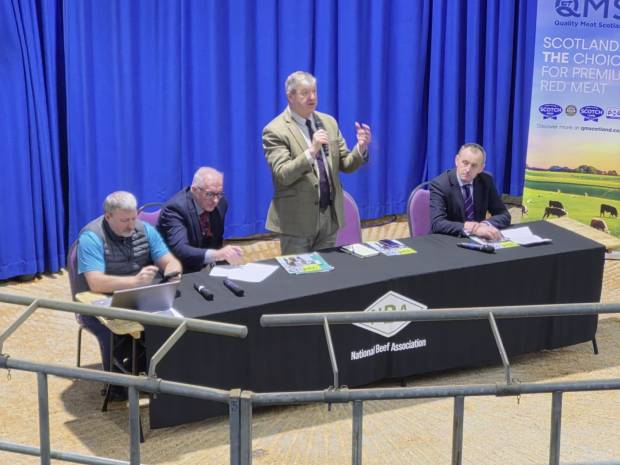
Over 100 people attended the meeting at Thainstone
Over 100 beef producers, policymakers and industry leaders gathered at Thainstone on Thursday, February 19, as the Scottish Beef Association (SBA) stepped up its Keeping Cows in the Community campaign, warning that Scotland risks losing critical mass in its beef sector unless support is better targeted at active producers.
Chaired by SBA and National Beef Association chief executive Neil Shand, the open meeting focused on the future of livestock support, inheritance tax (IHT) reform, and the need to reverse long-term declines in cattle numbers.
Mr Shand said 79,000 additional cows were needed in Scotland to prevent further loss of market share to imports.
NFUS North East Regional Manager Lorna Paterson asked a question about carbon calculators
“ScotGovt has decided not to accept the Climate Change Committee recommendations to reduce the numbers of cows. We should celebrate that, this is very significant,” he said.
He described that decision, alongside the industry’s determination to rebuild numbers, as ‘two foundation stones’ for growing the national herd.
However, he was clear that the campaign would not centre on demanding more public money.
“We won’t be challenging the government for more money as the government is broke, both in Scotland and the UK,” he said.
Instead, he argued that existing budgets must be made to work better, with payments directed to those actively keeping livestock.
“We need to make the current support work better, so the money goes to the people who have cows now, and does not come to people who do not have cows. We need to make sure the allocated budget goes to active producers.”
IHT and BPR reform
Turning to inheritance tax and Business Property Relief (BPR), Mr Shand said recent threshold changes were ‘not perfect but it is a start’.
“The threshold argument is dead when this current government is in place,” he said, adding that the SBA campaign would now look beyond the immediate changes towards the next election.
Among its proposals are index-linking thresholds and creating a system that does not rely on a married person or civil partnership to maximise relief.
In a more controversial suggestion, he said the SBA wanted livestock removed from BPR calculations.
“The variability from livestock alone – it is too volatile and variable. Take it out,” he said.
The association plans to compile proposals from this and future meetings into a portfolio to present to the next Scottish Government following the Holyrood election in May.
Food security and critical mass
Guest speaker Alistair Carmichael MP, chair of the House of Commons Environment, Food and Rural Affairs (EFRA) Committee, said food production must be placed at the heart of government policy.
Drawing on his own farming background in Islay, he recalled how choughs disappeared from land when cattle were removed and returned when livestock came back.
“In Scotland we have set natural restoration and climate change measures and water courses as set up against food production when they are absolutely not,” he said.
“We need to get food production into the heart of the government’s plan. This is why the Scottish Beef Association campaign for cows in the community is so important.”
On IHT, he described the changes as ‘a climb down if not a U-turn’ and said the strength of the farming lobby’s response had been unprecedented.
“When the IHT changes were first mooted it saw the biggest interaction from the farming world into the political world in my entire time in politics,” he said.
He urged farmers not to disengage.
“If farmers think they have failed then they will disengage, which is not good… It is all to play for.”
Mr Carmichael also warned that cattle numbers are ‘falling off a cliff’ and that once critical mass in processing and supply chains is lost, ‘the industry is gone’.
“We need to say we value food security is national security,” he said, adding that while climate change must be addressed, policy must reflect a changed global context.
Support reform and active farming
Agricultural economist at SRUC, Steven Thomson outlined long-term declines of around 20% in cattle and sheep numbers since 2000, with a 22% fall in the north east.
He said the shift to flat-rate, area-based payments had disadvantaged regions such as Aberdeenshire and accelerated movement out of livestock.
“In the future we could get rid of entitlements and just pay people on their land type,” he suggested, with a clearer focus on activity requirements.
He noted a recent policy ‘flip’ from an emphasis on nature and climate towards supporting active farmers, potentially influenced by the farm minister.
“The next challenge is defining what an active farmer is,” he said.
Mr Thomson also floated the possibility of enhanced payments linked to livestock activity in permanent grassland areas and suggested that, if properly designed, such reforms could ultimately replace LFASS.
Head of livestock at Aberdeen and Northern Marts (ANM), John Angus highlighted the commercial impact of declining numbers.
“Our business relies on a healthy livestock industry,” he said.
“Last year [there were] on average 1.5 store cattle per consigner less… From 2023, two cattle less per consigner,” he said, warning that the ripple effects of decline extend throughout the rural economy.
While improved prices have offered some encouragement, he stressed the importance of maintaining stockmanship skills and backing active producers.
“If you are an active farmer you should be supported for feeding the nation,” he said.
Climate, trade and profitability
Discussion from the floor ranged from the Climate Change Committee’s remit to rewilding, trade negotiations and farm incomes.
Mr Carmichael cautioned that climate change cannot be ignored but said the CCC must take proper account of food security when making recommendations.
Steven Thomson SRUC, Neil Shand SBA, Alastair Carmichael MP and John Angus ANM (Image: web)
Mr Thomson warned against offshoring emissions by reducing domestic red meat production while consumption continues globally.
“No farm should be told they need to go to net zero. It is country-wide,” he said.
Questions were also raised about the proposed SPS (sanitary and phytosanitary) alignment agreement with the EU and the potential risks if implemented without adequate transition.
As debate closed, Mr Shand reiterated that rebuilding numbers would require both confidence and targeted support.
“At the moment Scottish abattoirs are running at 70%,” he said, arguing that Scotland had already lost critical mass in parts of the sector.
The SBA’s message was clear: without a strategy informed by farmers and focused on active production, decline will continue. With the next Scottish election on the horizon, the association intends to ensure beef producers’ voices remain firmly in the political debate.
